


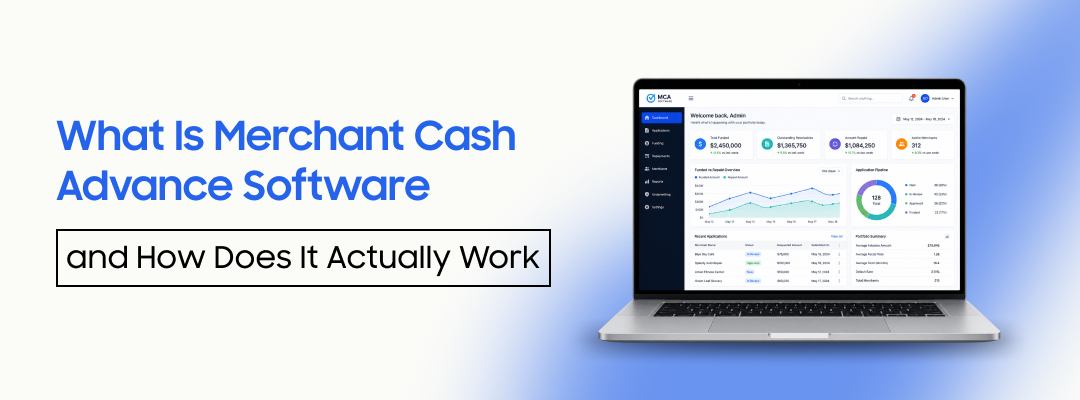
What Is Merchant Cash Advance Software and How Does It Actually Work
If your MCA team is still juggling spreadsheets, email chains, and a CRM that was never built for daily ACH pulls, you already know the drill. Deals slip through the cracks. Renewals get missed. Reconciliation is a headache every single morning.
That's exactly the gap merchant cash advance software is built to close.
But a lot of people entering the MCA space, funders, ISOs, and fintech founders, aren't totally clear on what MCA software actually does versus what a regular CRM or a generic loan origination system handles. This post breaks it down without the jargon.
What Is Merchant Cash Advance Software?
At its core, MCA software is the operating backbone behind a modern merchant cash advance business. It automates the full funding lifecycle from the moment a merchant submits an application all the way through daily collections, syndicate payouts, and renewal tracking, inside one system.
A regular CRM tracks contacts and deal pipeline. That's a sales tool. MCA software is a completely different animal. It calculates daily ACH pulls, manages factor rates, tracks holdback adjustments, allocates payments across syndicators, and generates the reports your capital partners need. A CRM can't do any of that natively, which is why most MCA funders eventually outgrow generic tools and hit a ceiling on how many deals they can actually manage.
Whether you fund deals directly or run a broker shop placing them elsewhere, the right platform automates the whole lifecycle: origination, underwriting, funding, ACH remittance, servicing, and renewals.
How a Merchant Cash Advance Actually Works
Before we get into the software itself, you've got to understand how an MCA works, because the software is built entirely around that structure.
An MCA isn't a loan. It's the purchase of a merchant's future receivables. The funder provides upfront capital, and the merchant repays a fixed amount, calculated using a factor rate, through daily or weekly ACH withdrawals based on a percentage of sales.

For example, a $50,000 advance at a 1.3 factor rate requires $65,000 in total repayment. If the holdback is 15% of daily card sales, repayments rise and fall with revenue.
Traditional lending platforms just weren't made for this. Daily ACH, revenue-based repayments, broker-driven deal flow, none of that fits without a ton of custom work and someone patching the gaps by hand.
That's exactly why purpose-built MCA software exists.
How MCA Software Handles Each Stage of the Funding Lifecycle
Application Intake and Lead Management
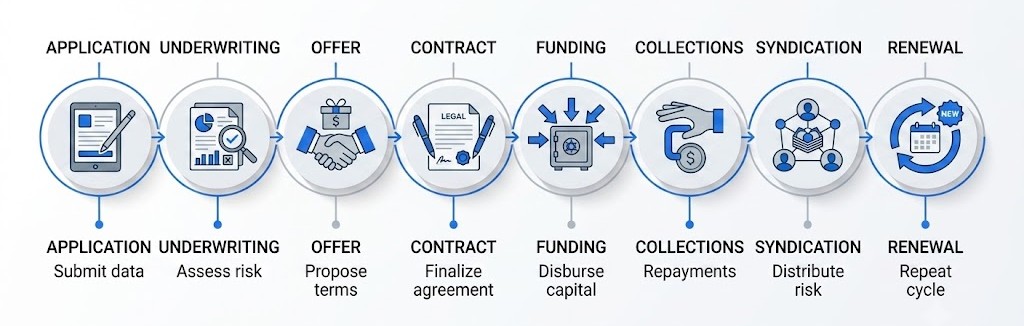
A good MCA platform starts with a streamlined application process. Merchants or brokers fill out the application, drop in their docs, link up their bank account, and check status without calling anyone. Sales, underwriting, and ops all pull from that same record, so nobody's typing the same info twice or following up on something that's already been taken care of.
Underwriting and Cash Flow Analysis
MCA underwriting cares about cash flow, deposits, existing advances, and how the business is actually performing, not a credit score. Purpose-built software pulls in bank statements on its own, reads the cash flow, flags any stacking, and hands underwriters what they need in minutes instead of hours.
Factor Rate Calculation and Offer Generation
Once a deal's approved, the platform works out factor rates, commissions, ISO splits, and repayment terms on its own. Multiple offer options go out instantly, no spreadsheet wrangling needed.
Contract Generation and E-Signature
The system builds contracts straight from the approved terms and fires them off for e-signature. Faster contracts mean faster funding, and fewer deals dying in someone's inbox.
Disbursement and ACH Setup
After signing, funds are disbursed through ACH or wire, while repayment schedules and ACH withdrawals are configured automatically without manual setup.
Daily Collections and Repayment Tracking
This is the part that keeps the lights on. The platform runs daily ACH collections, tracks repayments in real time, catches failed payments, adjusts holdbacks, and routes exceptions straight into collections.
Syndication Management
For syndicated deals, the platform splits repayments, sends out each partner's share, and generates statements on its own, no more burning an afternoon on spreadsheet reconciliation nobody trusts.
Renewals
The platform keeps an eye on repayment progress and flags renewal opportunities the moment a merchant's ready, so funders can reach out at the right time instead of guessing or catching it too late.
What Separates Purpose-Built MCA Software From Generic Platforms
The short answer: native support for how MCA actually works.
The real evaluation criteria is not feature breadth, but whether MCA is supported natively or requires ongoing configuration and engineering effort. Purpose-built MCA platforms reduce hidden costs and deployment time.
Generic loan origination systems handle standard amortizing loans well. They're not designed for daily ACH, factor rate logic, holdback adjustments, or ISO commission splits. Retrofitting a generic LOS to cover all that means more engineering hours up front, more maintenance forever, and usually your team still ends up filling the gaps by hand anyway.
If MCA's your core product, build your software around it from day one, not bolt it onto something made for a whole different job.
When Should You Build Your Own MCA Platform
Off-the-shelf MCA software covers a lot of ground for funders who are getting started or operating at modest volume. But as your operation scales, you start running into constraints: you can't customize the underwriting logic; you're capped by the vendor's feature roadmap, and white-labeling options are limited.
That's when building a custom MCA platform starts making real sense. A custom build gives you full control over deal flow logic, ISO portal customization, syndication structures, and integrations with the exact payment of rails and data providers you want to use.
Outgrowing your current setup?
Here's the full breakdown on what a custom lending platform actually costs, how long it takes, and what goes into building one: The Complete Guide to Building a Lending Software Platform
FAQ
-
Is MCA software the same as a loan management system?
-
No. Loan management systems are built for traditional loans with fixed repayments. MCA software is designed for factor rates, daily ACH collections, holdback-based repayments, and syndication.
-
Can a regular CRM replace MCA software?
-
No. A CRM can handle leads and pipeline stages fine, but it can't run ACH collections, work out factor rates, split syndicate payouts, or flag renewals.
- Do I need custom MCA software or an off-the-shelf solution?
-
It depends. Off-the-shelf platforms work well for most MCA businesses, while custom software is better suited for unique underwriting rules, branded portals, or specialized integrations.
-
What integrations does MCA software need?
-
Most platforms hook into ACH processors, bank data providers like Plaid, e-signature tools, and document storage at minimum. Larger operations usually tack on credit bureaus, fraud detection, and CRM integrations too.
Running an MCA operation that's starting to outgrow its current setup? IOCOD builds custom MCA platforms and lending software tailored to exactly how your business funds, collects, and scales. Talk to our team and let's figure out what your platform actually needs.